BPMN Pools and Lanes: Show Who Does Each Step
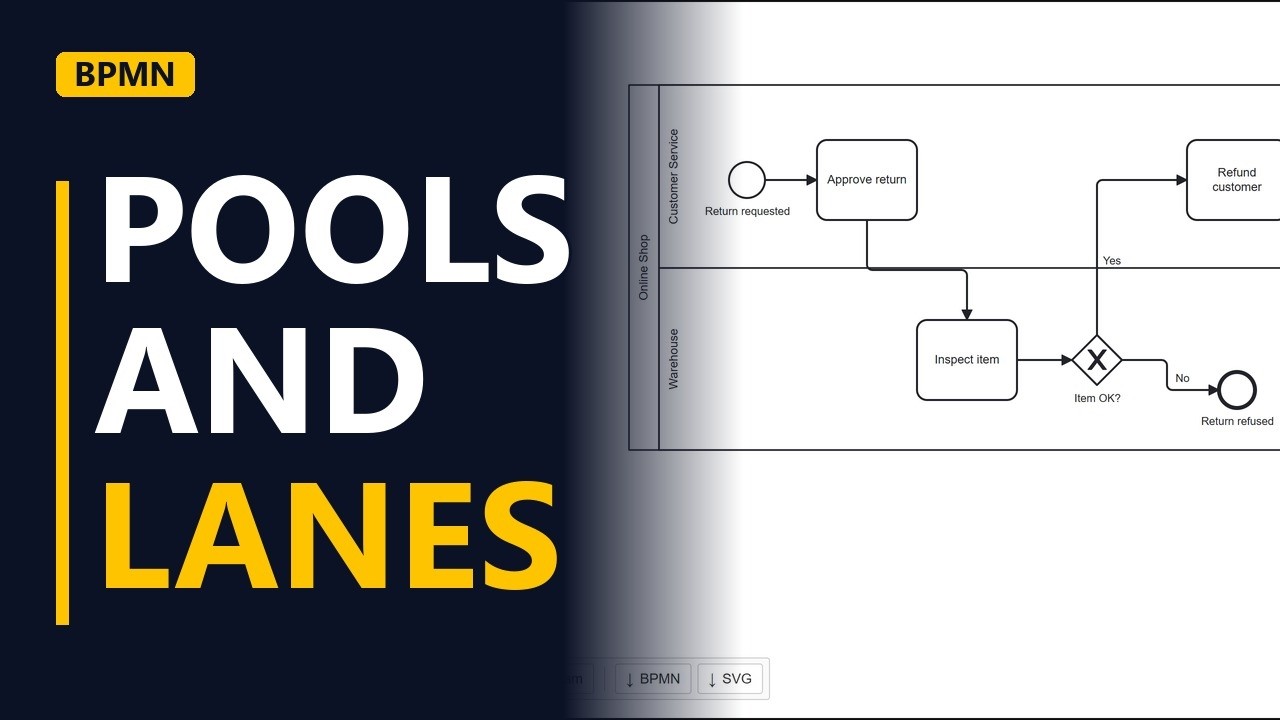
Show who does what in a BPMN model. Add a pool for the organisation and lanes for each team in the free bpmn.io modeler, then place every task in its lane, using an online shop's returns process.
Step by step
Who does what
- Pools and lanes. A process model that doesn't show who does each step leaves the most important question open. Pools and lanes fix that. Here's the returns process we'll draw for our online shop.
- New diagram. Start a new diagram in bpmn.io and name the start event return requested.
Pool
- Pool. Drag the pool from the bottom of the palette onto the canvas. A pool is one organisation, here the online shop. It takes in the start event. Make it bigger, then name it. Drag the start event a little up and to the right. That leaves room on the left for the lane names we add next.
Lanes
- Lanes. Click the pool and choose divide into two lanes. A lane is a team or a role inside the pool. Name them customer service and warehouse.
- Steps in lanes. Customer service approves the return. Add a task from the start event. Approve return. The warehouse checks the item, so drag a task from the palette into the warehouse lane. Inspect item. Connect them. Click approve return, take the arrow tool from its menu, and drop it on inspect item. The arrow crossing lanes shows the hand-over.
- Decision. Add a gateway after the inspection and ask item OK? If yes, customer service pays the money back. Drag a task from the gateway's menu up into their lane. Refund customer, and label the arrow yes.
- Ends. End that path. Refund paid. If no, the return is refused in the warehouse lane. Drag an end event below, name it return refused, and label the arrow no.
- Lanes. Now anyone can read who does what. Everything in this lane is the warehouse's job.
- The finished model. Click away to see the whole returns process, one pool, two lanes, every step in its lane.
Recap
- The rules. So, one pool per organisation, one lane per team or role, every task fully inside its lane, and arrows that cross lanes for hand-overs. Subscribe for more BPMN tips for business analysts.